Treatment of chlamydial infections
Antibiotic resistance presentation.
[The following is a
presentation on chlamydial antibiotic resistance given by Dr Geoffrey Ridgway,
London, at the international chlamydia conference in Antalya, Turkey in June
2002].
 |
 |
 |
 |
Fig 1. Title
slide. Double click on the thumbnailed images. This presentation © Dr
Geoffrey Ridgway, 2002.
Antibiotic
resistance may be broadly classified into microbial resistance and clinical
resistance. Microbial resistance is resistance intrinsic or inherent
to the microbe, i.e. to chlamydiae.
|
Fig 2. Clinical resistance is
more complex, and relates to the probability that there will not be
a response to apparently optimal therapy. Reasons may include microbial resistance, persistence of the
micro-organism, polymicrobial infection, adverse pharmacology
(particularly pharmacokinetics), side effects leading to poor
compliance, failure of
the antimicrobial to reach the site of infection, and reduced
patient immunity.
|
Fig 3. One
problem is the non specific nature of many of the syndromes associated
with chlamydiae, particularly genital and respiratory tract infections. |
Fig 4. Early
studies in eggs soon demonstrated that chlamydiae are intrinsically resistant to aminoglycosides, antifungals and
polymixins [Gordan & Quan, 1962],
but sensitive in part to penicillins, tetracyclines,
sulphonamides (some species) and macrolides such as erythromycin [Werner,
1961].
|
 |
 |
 |
 |
| Fig 5. The possibility of
acquired resistance was of early concern, with description of strains of
C. trachomatis showing decreased resistance to
tetracyclines, penicillins and sulphonamides in egg culture system [Shiaio
et al., 1967]. Keshishyan et al.,
1973 demonstrated the
rapid emergence of resistance to rifampicin following serial passage
of C. trachomatis in eggs.
|
Fig 6. Cell
culture made it easier to do antibiotic resistance experiments on
chlamydiae, but there were all too many variables, summarised here,
which could affect the results. |
Fig 7. Cell
culture studies: antibiotics to which chlamydiae were found to be
inherently resistant. |
Fig 8. Antibiotics
with only limited activity against chlamydiae. In the old chlamydial
taxonomy, an important difference was that C. trachomatis was generally
sensitive to sulphonamides whereas C. psittaci, (which we would
now regard as Chlamydophila species) were relatively resistant. |
 |
 |
 |
 |
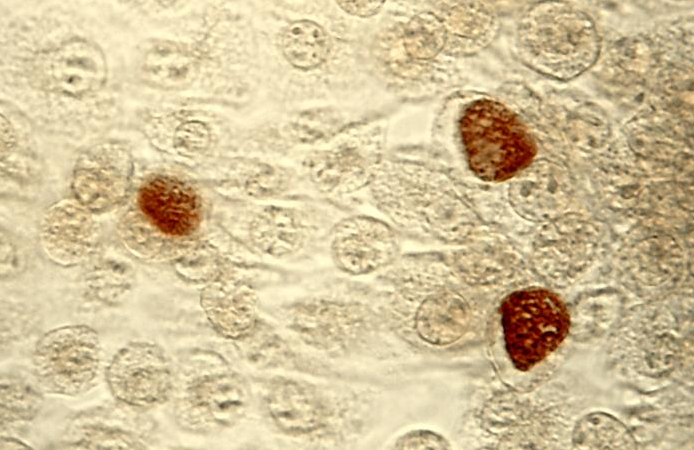
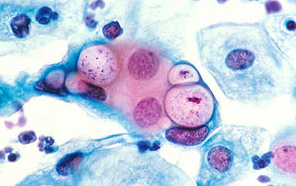
| Fig 9. Fluorescence
micrograph of C. trachomatis stained with the DNA and RNA binding dye,
acridine orange. The slide shows the aberrant, unusually large
reticulate body like structures caused by treatment with
ß-lactam
antibiotic, such as penicillin, to which chlamydiae are partly
susceptible. |
Fig 10. As for
Fig 9, but no antibiotic treatment, i.e. a control. |
Fig 11. In
chronic infections like trachoma, chlamydiae may be able to persist in
the absence of obvious clinical signs [Hannah
et al., 1968]. It is thought that chlamydiae in
chronic infection may enter a persistent state characterised by aberrant
reticulate bodies similar to those shown in Fig 9. See: persistent
infection & also cell
biology. |
Fig 12. Mourad
et al., 1980 were
the first to report reduced sensitivity to erythromycin. In a study of 6 oculo-genital isolates, 2 strains had
MICs for erythromycin of 0.5mg/l, with cidal concentration in excess
of 1.0 mg/l. Curiously, there was no cross resistance with
rosaramicin (an experimental macrolide available at that time). They
considered this was unlikely to lead to clinical
resistance, but they expressed caution.
|
 |
 |
 |
 |
| Fig 13. Although
it was possible to demonstrate the rapid emergence of resistance to
rifampicin on serial passage, Jones et
al., 1983 were unable to
produce resistance to oxytetracycline or to erythromycin by similar
techniques. In fact in sub inhibitory concentrations these latter two
antibiotics could help prevent the emergence of rifampicin resistance,
illustrating that the interactions between anti chlamydial antibiotics
may be complex. |
Fig 14. Decreased
sensitivity to tetracyclines resulting in clinical failure was first
reported by Jones et al., 1990. They
identified 5 isolates from cases of tubal infertility which had MICs to
tetracycline of 4 to >8mg/l, compared with control MICs of 0.125 to
0.25 mg/l.
The isolates were also resistant to erythromycin, clindamycin and sulphonamide,
but sensitive to ciprofloxacin and ofloxacin. The resistant organisms
were present in small numbers (<1%) within the chlamydial population
and they were unstable, tending to lose both resistance and viability in
cell culture. In at least one case resistance was associated with poor
clinical response. |
Fig 15. Studies
by Rice et al., 1995 indicated that disease severity was associated with
decreased susceptibility to the chlamydiacidal action of
doxycycline, azithromycin, ofloxacin, clindamycin, amoxicillin, or
cotrimoxazole. |
Fig 16. Tetracycline
resistance was also reported from France Lefevre et al.,
1997. The MIC for
tetracycline was >64 mg/l, and again, only 1% of the population
expressed resistance. The patient was cured with pristinamycin; a
curious choice in view of the lack of published trials against
chlamydiae. Unlike the strains reported by Jones
et al., 1990, this
strain was normally sensitive to azithromycin, erythromycin, ofloxacin
and pristinamycin leading to the suggestion that the tetracycline
resistance was a newly emergent problem. |
 |
 |
 |
 |
| Fig 17. Multiple
drug resistant isolates of C. trachomatis associated with treatment
failure with azithromycin were reported by Somani et
al., 2000. Three patients were described (2 treatment
failures and the wife of one). The three isolates were solidly resistant
to doxycycline (MIC > 4.0 mg/l), and to ofloxacin (MIC 2.0 to >4.0
mg/l). |
Fig 18. Samra
et al., 2001 studied the sensitivity of 50 clinical isolates
of C. trachomatis to azithromycin, clarithromycin, roxithromycin,
erythromycin, doxycycline and tetracycline. They noted that 44% of
isolates had reduced sensitivity to tetracycline (MIC = or > 0.5
mg/l). The MBC to doxycycline and tetracycline was 4mg/l in 8% and 4% of
the strains respectively. |
Fig 19. Dreses-Werringloer et al., 2000 reported the induction of
persistence of C. trachomatis by ciprofloxacin or ofloxacin in
cell culture. Aberrant small inclusions were produced, which contained
viable but non-cultivatable organisms. Normal forms could be cultured on
removal of the quinolone. Persistence was characterised by reduced
production of the major outer membrane protein (MOMP), and persistent
levels of heat shock protein 60 (HSP60). This is analogous to the
situation reported for ß-lactam antibiotics (Fig 9). This is
particularly disconcerting since quinolones active against chlamydiae
are normally chlamydiacidal at concentrations only just above inhibitory
levels. |
Fig 20. Two
studies have demonstrated that passage of C. trachomatis L2
strain in vitro in the presence of sub-inhibitory levels of
quinolones like ofloxacin, sparfloxacin and moxifloxacin resulted in a
stable 250 to 1000 fold elevation of MIC due to a Ser 83 to Ile mutation
in the quinolone resistance determining region (QRDR) of the gyrA gene [Desus-Babus
et al., 1998; Morrissey et al., 2002].
Interestingly under similar circumstances it was not possible to
demonstrate quinolone resistance for C. pneumoniae. |
 |
 |
 |
 |
| Fig 21. Widespread
resistance of C. suis to tetracycline has been reported. Lenart
et al., 2001 noted that a tetracycline resistant strain (MIC
4 mg/l) of C. suis produced large aberrant reticulate bodies,
similar to those noted (Fig 9) with ß-lactams. Co-cultivation
experiments demonstrated that both C. suis and C. trachomatis
could grow in the same inclusion, providing excellent opportunity for
transfer of resistance genes between these closely related species. |
Fig 22.
Antibiotic resistance is less readily produced by C. pneumoniae compared
with C. trachomatis. Hammerschlag and
Roblin 2000 studied 10 patients with C. pneumoniae infection
who had been treated with moxifloxacin. The organism persisted in 3
patients post therapy, but the MICs and MBCs of pre and post treatment
isolates were the same. C. pneumoniae was eradicated from four of four
patients receiving clarithromycin in the same study. However other
studies with macrolides, reviewed by Boman
and Hammerschlag, 2002 noted a four fold increase in MIC in two of 3
studies to azithromycin. |
Fig 23. Some
conclusions. Understanding the response of chlamydiae to
antibiotics involves: Firstly, the ability of the antibiotic to kill and
not just inhibit the organism; Secondly, any role of the antibiotic in
inducing persistent infection; and Thirdly the ability of the organism
to develop stable resistance. There is an urgent need to develop
standardised methods to investigate antibiotic activity, perhaps
utilising new technologies such as reverse transcriptase PCR [Cross
et al., 1999], microelectronic chip arrays [Westin
et al., 2001], or animal models [Stamm, 2000].
There is no doubt that both C. trachomatis and C. pneumoniae
are capable of developing sophisticated systems to evade eradication by
antibiotics.
|
Fig 24. Should
we be clinically concerned about antibiotic resistance in
chlamydiae? |
 |
 |
| Fig 25. The
self-evident answer. |
Fig 26. It may
be that it is very difficult to completely kill C. trachomatis in
vivo. Perhaps all available antibiotics under certain circumstances
may induce persistent infection. Such a concept, if true, would be far
reaching for dealing with the long term sequelae of chlamydial
infections, such as chronic pelvic infection, infertility, blindness and
perhaps coronary artery disease. This concept is not new for genital
chlamydial infection, having been previously proposed by Oriel
and Ridgway 1982 and Stamm, 2001 . |
[GR] Jan 2003
NEXT: Treatment
index
PREVIOUS: Antibiotic resistance part
1.
References
Boman, J. & Hammerschlag, M. (2002). Chlamydia
pneumoniae
and atherosclerosis: critical assessment of diagnostic methods and relevance to
treatment studies. Clinical Microbiology Reviews 15, 1 - 20. Full
article
Cross,
N. A., Kellock, D. J., Kinghorn, G. R., Taraktchoglou, M., Bataki, E., Oxley,
K.M., Hawket, P. & Eley, A. (1999). Antimicrobial
susceptibility testing of Chlamydia trachomatis using a reverse
transcriptase PCR-based method. Antimicrobial
Agents and
Chemotherapy
43,
2311 - 2313. Full
article

Dessus-Babus, S., Bebear, C. M., Charron, A., Bebear, C. & de Barbeyrac, B.
(1998).
Sequencing of gyrase and topoisomerase IV quinolone-resistance-determining
regions of Chlamydia trachomatis and characterization of quinolone-resistant
mutants obtained in vitro. Antimicrobial Agents
and Chemotherapy 42, 2474 - 2481.

Full
article
Dreses-Werringloer, U., Padubrin, I., Jurgens-Saathoff, B., Hudson, A. P.,
Zeidler, H. & Kohler, L. (2000). Persistence
of Chlamydia trachomatis is induced by ciprofloxacin and ofloxacin in
vitro. Antimicrobial Agents and Chemotherapy 44,
3288 - 3297. Full
article
 ![[Acrobat]](http://www.som.soton.ac.uk/images/acrobat.gif)
Gordon, F. B. & Quan, A. (1962). Drug susceptibilities of the
Psittacosis and Trachoma agents. Annals New York Academy of Science 98, 261 - 270.
Hammerschlag, M. R. & Roblin, P. M. (2000). Microbiologic
efficacy of moxifloxacin for the treatment of community-acquired pneumonia due
to Chlamydia pneumoniae. International Journal of Antimicrobial
Agents 15, 149 - 152.
Hannah, L., Dawson, C. R., Briones, O., Thygeson, P. & Jawetz, E.
(1968). Latency in human infections with TRIC agents. Journal of Immunology
101, 43 - 50.
Jones, R. B., Ridgway, G. L., Boulding, S. & Hunley, K. L.
(1983). In
vitro
activity of rifamycins alone and in combination with other antibiotics against Chlamydia
trachomatis. Reviews of Infectious Diseases 5, Supplement
3: S556 - 561.
Jones, R. B., Vanderpol, B., Martin, D. H. et
al., (1990). Partial characterization of C. trachomatis isolates resistant to multiple
antibiotics. Journal of Infectious Diseases 162, 1309 - 1315.
[Describes 5 relatively tetracycline resistant strains
with diminished viability].
Keshishyan, H., Hanna, L., Jawetz,
E. (1973). Emergence of Rifampin resistance in Chlamydia trachomatis.
Nature 244, 173 - 174
Koonin, E. V., Makarova, K. S. & Aravind, L. (2001). Horizontal
gene transfer in prokaryotes: quantification and classification. Annual
Reviews of Microbiology
55, 709 -
742. [Scholarly
Review].

Lefevre, J. C., Lepargneur, J. P., Guion, D. & Bei, S.
(1997). Tetracycline-resistant
Chlamydia trachomatis in Toulouse, France. Pathologie Biologie
(Paris) 45, 376 - 378.
Lefevre, J. C. & Lepargneur, J. P. (1998). Comparative in vitro
susceptibility of a tetracycline-resistant Chlamydia trachomatis strain
isolated in Toulouse (France). Sexually
Transmitted
Diseases
25, 350
-
352.
[Describes an isolate
resistant to 64 micrograms per ml of tetracycline].

Lenart, J., Andersen, A. A. & Rockey, D. D. (2001). Growth
and development of tetracycline-resistant Chlamydia suis. Antimicrobial
Agents and Chemotherapy
45, 2198
- 2203. Full
article

Morrissey, I., Salman, H., Bakker, S., Farrell, D., Bebear, C. M. &
Ridgway, G. (2002).
Serial passage of Chlamydia spp. in sub-inhibitory fluoroquinolone
concentrations. Journal of Antimicrobial Chemotherapy
49, 757 - 761.
Mourad, A., Sweet, R. L., Sugg, N. & Schachter, J. (1980). Relative
resistance to erythromycin in Chlamydia trachomatis. Antimicrobial
Agents and Chemotherapy 18, 696 - 698.
Oriel, J. D. &
Ridgway, G. L. (1982). Epidemiology
of chlamydial infection in the human genital tract: evidence for latent
infections. European
Journal
of Clinical
Microbiology
1: 69 - 75.
Rice, R. J., Bhullar, V., Mitchell, S. H., Bullard, J. & Knapp, J. S.
(1995). Susceptibilities
of Chlamydia trachomatis isolates causing uncomplicated female genital
tract infections and pelvic inflammatory disease. Antimicrobial Agents
and Chemotherapy 39, 760 - 762. Full
article
Ridgway, G. L. (1997). Treatment of chlamydial genital
infection. Journal of Antimicrobial Chemotherapy 40, 311 -
314. Full
article
[Good
review].
Samra, Z., Rosenberg, S., Soffer, Y. & Dan, M. (2001). In
vitro
susceptibility of recent clinical isolates of Chlamydia trachomatis to
macrolides and tetracyclines. Diagnostic Microbiology and
Infectious Disease 39, 177 - 179.
[4 to 8% of isolates in
Israel relatively resistant to tetracyclines].
Shiao, L., Wang, S. P., Grayston, J. T. (1967). Sensitivity and
resistance of TRIC agents to penicillins, tetracycline and sulpha drugs. American
Journal of Ophthalmology 63, 532 - 542.
Somani, J., Bhullar, V. B,, Workowski, K. A,, Farshy, C. E. & Black, C. M.
(2000).
Multiple drug-resistant Chlamydia trachomatis associated with clinical
treatment failure. Journal of Infectious Disease
181, 1421 - 1427.
Stamm, W. E. (2000). Potential
for antimicrobial resistance in Chlamydia pneumoniae. Journal of
Infectious Diseases 181 Suppl 3: S456 - 459.
Stamm, W. E. (2001). Chlamydia
trachomatis:
the persistent pathogen. Sexually Transmitted Diseases 13, 684 - 689.
Tulkens, P. M. (1991). Intracellular distribution and activity of
antibiotics. European Journal of Clinical Microbiology and Infectious
Disease 10, 100 - 106. [Interesting review]
Werner, G. H. (1961). Recherches Expérimentales sur la Chimotheripi
Du Trachome. Annales de L'Institut Pasteur 100, 93 - 108.
Westin, L., Miller, C., Vollmer, D., Canter, D., Radtkey, R., Nerenberg,
M. & O'Connell, J. P. (2001). Antimicrobial
resistance and bacterial identification utilizing a microelectronic chip array.
Journal of Clinical Microbiology 39, 1097 - 1104. Full
article
|