|
|
|
AttachmentChlamydial infection is initiated by the attachment of the chlamydial elementary body to the host cell. At temperatures below 20 22C, attachment still occurs, but entry does not. Thus attachment, which is really part of the same process as entry, can be investigated separately but often isn't.
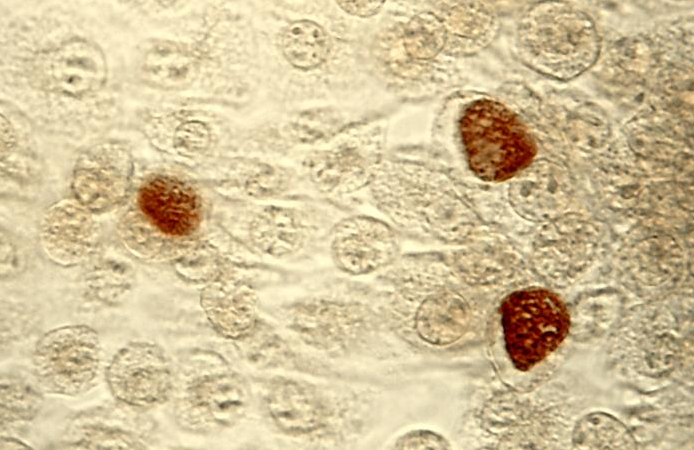
As the negatively chlamydial elementary body approaches the negatively charged host cell surface, there is an electrostatic repulsive barrier to be overcome. From the DLVO theory of colloid physics (Derjaguin-Landau-Verwey-Overbeek theory) the energy of interaction of two charged particles of like sign and magnitude is the sum of the electrostatic energy of repulsion and the energy of attraction provided by electromagnetic interactions due to London-van der Waal's forces [Watt & Ward, 1980]. Penetration through the electrostatic repulsive barrier will be minimized by a small radius of curvature between the approaching surfaces. For this reason, initial chlamydial contact is likely to be with microvillous appendages of the host cell, as is observed in practice (Figs 1 and 2). With respect to attachment, the two main biovars of C. trachomatis clearly behave differently. For the trachoma biovar, positively charged macromolecules such as DEAE dextran or poly-L-lysine, increase chlamydial infectivity for HeLa cells in tissue culture. This is not the case for the LGV biovar [Kuo et al., 1973]. This probably reflects the ability of positively charged molecules to neutralise the net negative charge at the host cell surface, coupled with the fact that LGV strains are less negatively charged. The dominant proteins in the outer membrane complex of C. trachomatis are MOMP and the cysteine-rich proteins of molecular weights 12-15 KDa and ~ 40 KDa respectively. These proteins are less negatively charged in the LGV biovar strains than in trachoma biovar strains [Hackstadt, 1999]. This would reduce the electrostatic barrier to attachment for the LGV biovar strains and might be one explanation as to why these strains do not require centrifugation to efficiently infect susceptible cells in laboratory culture. Figs 3 and 4 show the effect of different concentrations of negatively charged molecules on the infectivity of LGV and trachoma biovar strains of C. trachomatis:
Attempts to define chlamydial adhesins or the host cell receptors involved in chlamydial attachment have been inconclusive (reviewed in Hackstadt, 1999). N-acetylneuraminic acid and N-acetylglucosamine have been implicated as components of a putative host cell receptor. However, C. trachomatis elementary bodies attach as efficiently to insect cells lacking these molecules as they do to the chlamydiae-susceptible McCoy cell line [Allan & Pearce, 1987]. Heparin and heparan sulphate or heparitinase treatment consistently inhibit the infectivity of C. trachomatis L2 [LGV biovar] for HeLa 229 cells [Zhang & Stephens, 1992; Taraktchoglou et al., 2001]. These belong to a family of molecules known as glycosamino glycans, or GAGs. GAGs are linear, negatively charged polymers consisting of repeating disaccharide repeats of an amino sugar and uronic acid. GAG residues are covalently linked to core proteins to form proteoglycans and they are found on the surface of most nucleated cell types. Heparan sulphate has the most complex molecular structure, being made up of a backbone of N-acetylated or N-sulphated amino sugars of D-glucosamine or galactosamine linked to glucuronic or iduronic acid, with complex patterns of O-sulfate substitutions. It has a wide range of functions, including the binding to extracellular matrix components such as fibronectin, collagen and laminin [Rostand & Esko, 1997; Taraktchoglou et al., 2001]. The other three members of this GAG family include the less sulphated hyaluronic acid, chondroitin sulphate and keratan sulphate which do not significantly inhibit LGV infectivity [Zhang & Stephens, 1992]. While heparan sulphate undoubtedly has an effect on the infectivity of the LGV biovar, its actual role is controversial. One school of thought is that the effect is non-specific and charge mediated, which would explain why the more sulphated and thus more negatively charged heparan sulphate is more inhibitory to LGV biovar infectivity via DLVO forces [Watt & Ward, 1980] than the less sulphated members of the GAG family. A second view, proposed by Zhang & Stephens, 1992 is that chlamydiae synthesize their own heparan sulphate-like GAG, which acts as a trimolecular bridge between the chlamydial envelope, chlamydial heparan and host cell heparan receptors. The infectivity of heparitinase-treated elementary bodies could be restored with heparan sulphate [Zhang & Stephens, 1992]. A heparan sulphate-specific monoclonal antibody specifically delineated GAG on the surface of C. trachomatis and C. pneumoniae, neutralising their infectivity. GAG staining was also observed on chlamydiae within the intracellular inclusion [Rasmussen-Lathrop et al., 2000]. There was some evidence that C. trachomatis L2 might synthesize GAG [Zhang & Stephens, 1992; Rasmussen-Lathrop et al., 2000]. Heparin and heparan sulphate were also found to inhibit the attachment of C. pneumoniae to human epithelial cells. Reduction in infectivity resulted from the binding of heparin to the organism. Enzymatic removal of heparan sulphate moieties from the host cell surface led to a marked decrease in C. pneumoniae infectivity. Mutant CHO cell lines defective in heparan sulphate biosynthesis were less susceptible to C. pneumoniae infection than was the wild-type cell line and preincubation of the GAG-deficient Chinese Hamster Ovary cells with exogenous heparin greatly increased infectivity [Wuppermann et al., 2002]. This evidence is not, in the view of this writer, definitive evidence of a key role of glycosaminoglycans in anything other than non specific [charge] interactions. If Chlamydia indeed synthesise glycosaminoglycans, which genes from the genome sequence form the biosynthetic pathway for its synthesis? This question needs to be addressed. Using flow cytometry, Taraktchoglou et al., 2001 were unable to find evidence for chlamydial-specified GAG. Hackstadt, 1999 points out chlamydial synthesis of GAG would be a novel biosynthetic pathway for any bacteria. However, as chlamydiae interact closely with the host cell Golgi apparatus, it is conceivable that both host and chlamydial enzymes might contribute to "chlamydial" GAG synthesis [Hackstadt, 1999]. A third view is that host cell surface GAG alone is sufficient for attachment [Su et al., 1996]. However, given the differential effects of GAG on the attachment and infectivity of different Chlamydiaceae species, it seems likely there are both GAG-dependent and GAG-independent mechanisms operating at different stages of the infection process. Thus, Carabeo & Hackstadt, 2001 isolated a a mutant cell line of Chinese hamster ovary cells that was refractory to infection by C. trachomatis L2 serovar. The mutant cell line apparently lacked a temperature-dependent and heparin-resistant binding step that occurred subsequent to the engagement of cell surface heparan sulphate by L2 elementary bodies. Such differences may contribute to the different pathologies associated with the trachoma and LGV biovars of C. trachomatis. The role of heparan sulphate might also be less straight-forward. The chicken pox virus attaches to host cells via a heparan sulphate proteoglycan whose function is to stabilise the virus so that it can interact with cellular mannose-6-phosphate receptor to effect entry [Zhu et al., 1995]. In this context, the fact that MOMP has high mannan oligosaccharide side chains may be very relevant. It is likely that chlamydial attachment / entry is a dynamic process involving multiple receptors. Using thin layer chromatography, Krivan et al., 1991 showed that elementary bodies of both C. trachomatis and C. psittaci bound to phosphatidyl-ethanolamine and to the common host cell glycolipids asialo-GM1 and asialo-GM2. Surprisingly this observation has not been further pursued, although pretreatment of L929 cells in tissue culture with Arum maculatum lectin, which binds to sialo glycoprotein, blocks C. pneumoniae infection [Mladenov et al., 2002]. Similar difficulties of distinguishing specific from non-specific effects confound attempts to identify the chlamydial adhesin(s) involved in chlamydial attachment to the host cell. The differential effect of trypsinization on the attachment of a serovar B and LGV biovar strain to cells has lead to the suggestion that chlamydial MOMP may be involved. Comparison of MOMP variable sequences 2 and 4 shows that, in C. trachomatis serovar B, there is a trypsin-sensitive lysine that is absent from that region of C. trachomatis serovar L2 [Su et al., 1992]. As only two strains were compared, this observation, although widely quoted, cannot be considered definitive. However an unusual feature of C. trachomatis MOMP is that it is N-glycosylated with a high mannose oligosaccharide side chain. This is rare in the kingdom Eubacteria [Lechner & Wieland, 1989]. However as chlamydiae are intracellular bacteria, it is possible the N-glycosylation is performed by host cell enzymes. The oligomannan side chain, cleaved off MOMP with glycanase, itself binds to HeLa 229 cells and inhibits chlamydial attachment and infectivity [Swanson & Kuo, 1994]. The possible role of a chlamydial glycoprotein in attachment is also suggested by the differential ability of glycoprotein-binding plant lectins to block it. N-linked high mannose oligosaccharides competitively inhibit attachment to (and infectivity of chlamydiae in) HeLa cells. C. trachomatis infects mannose-receptor positive J774E mouse macrophages better than the equivalent J774A mannose-receptor negative cells. In contrast, C. psittaci infected both mannose-receptor negative and positive cells equally well, while C. pneumoniae infected mannose-receptor negative cells better than mannose-receptor positive cells. Thus there are species differences in the attachment, entry and survival of chlamydiae in mouse macrophages [Kuo et al., 2002].
[Comment: The chlamydial adhesin(s) and host cell receptor(s) involved in attachment have yet to be definitively identified. It seems likely that there are significant differences between the C. trachomatis oculo-genital and LGV biovars, and also between C. trachomatis and the other species. This is an experimental area fraught with difficulties, particularly differentiating specific from non-specific effects. By comparison with some of the virus specific attachment mechanisms, chlamydiae have relatively low attachment avidity to host cells. However, it is unlikely that chlamydial attachment has been left to chance as it is a critical step in the chlamydial life cycle. Perhaps chlamydiae can attach to, and enter, cells by a variety of weak, multivalent interactions to common cell surface components, thereby explaining their ability to infect a relatively wide variety of cells. Finally, virtually all the studies so far have been with C. trachomatis; there have been no studies of families other than the Chlamydiaceae.] [MEW] May 2002 Index: Biology index. NEXT: Entry into host cells. Allan, L & Pearce, J. H. (1987). Association of C.
trachomatis with mammalian and cultured insect cells lacking putative chlamydial
receptors. Microbial Pathogenicity 2, 63 - 70. Carabeo, R. A. & Hackstadt, T. (2001). Isolation
and characterization of a mutant Chinese hamster ovary cell line that is
resistant to Chlamydia trachomatis infection at a novel step in the
attachment process. Infection and Immunity 69,
5899 - 5904. Full
article Hackstadt, T. (1999). Cell biology. In: Chlamydia: Intracellular Biology, Pathogenesis, and Immunity, pp. 101-138. Edited by R. S. Stephens. Washington, D.C.: ASM Press. ISBN 1-55581-155-8. Krivan, H. C., Nilsson, B., Lingwood, C. A. & Ryu, H.
(1991). C. trachomatis and C. pneumoniae bind specifically to
phosphatidylethanolamine in HeLa cells and to GALNACbeta1-4GALbeta1-4GLC sequences found
in asialo-GM1 and asialo-GM2. Biochemical Biophysical Research Communications 175,
1082 - 1089. Kuo, C-C., Puolakkainen, M., Lin, T. M., Witte, M. & Campbell, L. A.
(2002). Mannose-receptor
positive and negative mouse macrophages differ in their susceptibility to
infection by Chlamydia species. Microbial Pathogenicity
32, 43 - 48. Kuo, C-C., Wang, SP. & Grayston, J. T. (1973). Effect of polycations, polyanions, and neuraminidase on the infectivity of trachoma-inclusion conjunctivitis and lymphogranuloma venereum organisms in HeLa cells: sialic acid residues as possible receptors for trachoma-inclusion conjunctivitis. Infection and Immunity 8, 74 - 79. Lechner, J & Wieland, F. (1989). Structure and biosynthesis of prokaryotic glycoproteins. Annual Reviews of Biochemistry 58, 173 - 194. [Good review] Mladenov, I. V., Haralambieva, I. H., Iankov, I. D. & Mitov, I. G. (2002). Characterisation of 20-kDa lectin-spermagglutinin from Arum maculatum that prevents Chlamydia pneumoniae infection of L-929 fibroblast cells. FEMS Immunology and Medical Microbiology 32, 249 - 254. Rasmussen-Lathrop, S. J., Koshiyama, K., Phillips, N.,
Stephens, R. S. (2000). Chlamydia-dependent
biosynthesis of a heparan sulphate-like compound in eukaryotic cells. Cellular
Microbiology 2, 137 - 144. Rostand, K. S. & Esko, J. D. (1997). Microbial adherence
to, and invasion through, proteoglycan. Infection and Immunity 62,
106 - 112. [Good review] Full
article Su, H., Raymond, L., Rockey, D. D., et al., (1996).
A
recombinant C. trachomatis major outer membrane protein binds to heparan sulfate
receptors on epithelial cells. Proceedings of the National Academy of Sciences USA 93,
11143 - 11148. Full
article Su, H., Zhang, Y-X., Barrera, O., et
al., (1988). Differential
effect of trypsin on infectivity of C. trachomatis: loss of infectivity requires
cleavage of major outer membrane protein variable domains II and IV. Infection
and Immunity 56, 2094 - 2100. Swanson, A. F. & Kuo, C-C. (1994). Binding of the glycan
of the major outer membrane protein of C. trachomatis to HeLa cells.
Infection
and Immunity 62, 24 - 28. Taraktchoglou, M., Pacey, A. A., Turnbull, J. E. & Eley, A. (2001).
Infectivity
of Chlamydia trachomatis serovar LGV but not E is dependent on host cell
heparan sulfate. Infection and Immunity 69,
968 - 976. Full article
Watt, P. J. & Ward, M. E. (1980). Adherence of Neisseria gonorrhoeae and other Neisseria species to mannalian cells. Pages 251-288. In: Bacterial adherence. (Beachey, E. H. ed.). Chapman & Hall, London. ISBN 0 412 21730 9. Wuppermann, F. N., Hegemann, J. H. & Jantos, C. A. (2001). Heparan sulfate-like glycosaminoglycan is a cellular receptor for Chlamydia pneumoniae. Journal of Infectious Diseases 184, 181 - 187. Zhang, J. P. & Stephens, R. S. (1992). Mechanism of C. trachomatis attachment to eukaryotic cells. Cell 69, 861 - 869.Zhu, Z., Gershon, M. D., Ambron, R., et
al., (1995).
Infection of cells by Varicella zoster virus: inhibition of viral entry by mannose
6-phosphate and heparin. Proceedings of the National Academy of Sciences USA
92, 3546 - 3550. Full
article
Index: Biology index. NEXT: Entry into host
cells. |